
- TIH Limited- Who will emerge as the biggest winner from the unconditional offer?
Earlier this month, Lippo China Resources Limited (“LCR”) and funds managed by and including Argyle Street Management Limited (“ASM”) jointly launched a voluntary unconditional offer of 57 cts for each TIH share pursuant to a consortium agreement signed on the same day. The offer is made through Kaiser Union Ltd (“Bidco”), an SPV wholly owned by LCR.
Of the 57 cts per share, 12.5 cts is to be paid in cash with the remaining 44.5 cts to be paid in the form of a 3 year 2.25% unlisted unsecured senior bond issued at par by the Bidco. ASM and its funds have already undertaken to tender a maximum of 110,732,656 TIH shares equivalent to 45.8% of the total issued share capital in acceptance of the offer. The number of shares to be tendered by ASM and its funds will be reduced by the aggregate number of shares tendered by minority shareholders and acquired through open market purchases made by the Bidco.
Based on the responses so far, it seems that the offer has not been received well by the minority shareholders. While it remains to be seen if shareholders have indeed been short-changed, we think one big winner has already emerged regardless of the outcome of the offer: the Lippo group.
Firstly, due to the undertaking by ASM and its funds, LCR is already assured of acquiring an initial 45.8% controlling stake in TIH based on its 100% ownership of Bidco (although Bidco, LCR and ASM may transfer TIH shares between themselves to achieve their desired shareholding levels within 12 months of offer close). If Lippo’s intention is indeed to expand its securities and fund investment business in Asia through TIH, then this is certainly a cost effective way to do so. Afterall, based on the undertaking shares, LCR need only pay a maximum amount of $13.8 mil upfront for the entire stake with the remainder mostly paid 3 years later.
Secondly, and perhaps more importantly, the move actually helps Lippo tighten its hold on OUE Ltd. To understand why, we only need to look at the simplified ownership chart compiled below: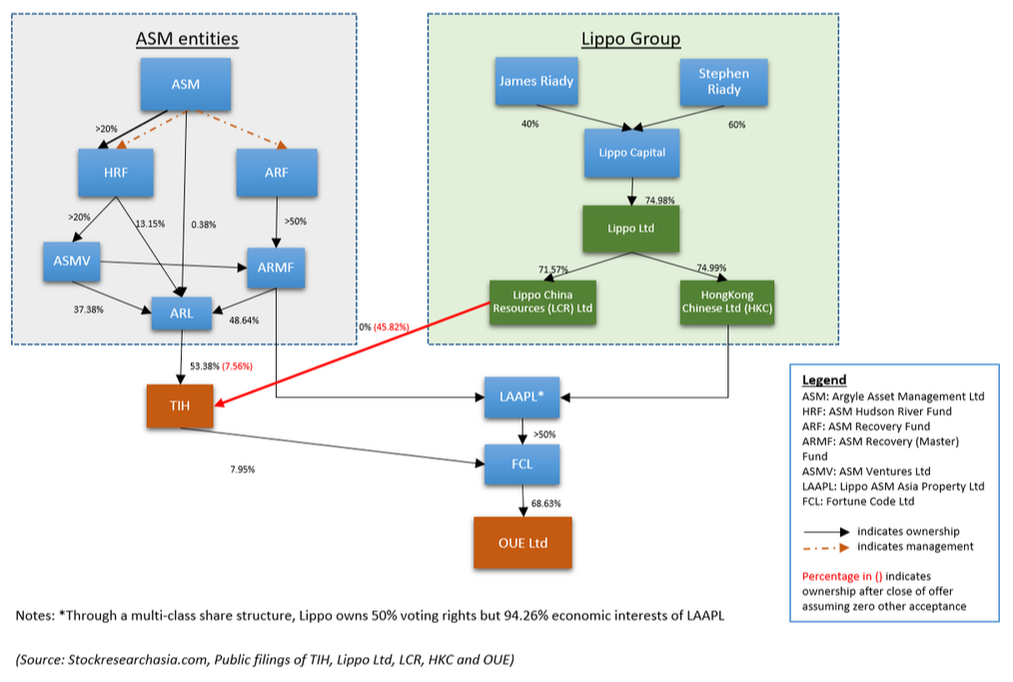
From the chart, we can see that ASM plays an integral role in Lippo’s control over OUE via the holding entities, Lippo ASM Asia Property Ltd (“LAAPL”) and Fortune Code Ltd (“FCL”).
In particular, ASM-controlled TIH currently owns a 7.95% stake in FCL which in turn controls more than 68% of OUE shares. Had ASM sold its stake in TIH to a 3rd party, Lippo would have to deal with a potentially unfriendly minority shareholder in FCL. The Joint Offer by ASM and Lippo’s LCR basically ensures that such a scenario would not happen.
On top of it, Lippo will now gain direct control over the stake in FCL held by TIH. All these for a upfront cash outlay which is unlikely to burn a hole in Lippo’s deep pockets.
In our opinion, this makes them the biggest winner in this takeover exercise, by far.
IMPORTANT NOTICE
We put money where our mouth is. As such, we do take positions in the securities mentioned on this website or any securities related thereto and may from time to time add or dispose of or may be materially interested in any such securities. The research materials provided on this site is for information only. Investors should seek the assistance of a qualified and licensed financial advisor in making their investment decisions. The research reports/notes are compiled based on information, which we believe to be reliable. Any opinions expressed reflect our judgment at as at the date of the reports or notes and are subject to change without notice. It does not have regards to the specific investment objectives, financial situation and the particular needs of any specific person who may receive or access this research material. Our recommendations are not to be construed as an offer, or solicitation of an offer to sell or buy securities referred herein. The use of this material does not absolve you of your responsibility for your own investment decisions. We accept no liability for any direct or indirect loss arising from the use of this research material. This research material may not be reproduced, distributed or published for any purpose by anyone without our specific prior consent.